
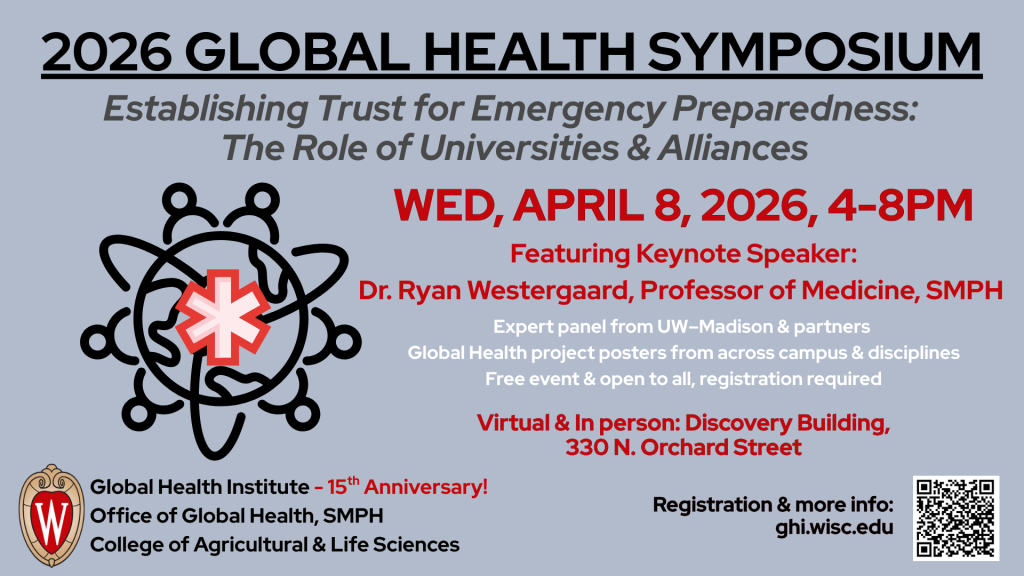
ESTABLISHING TRUST FOR EMERGENCY PREPAREDNESS: THE ROLE OF UNIVERSITIES & ALLIANCES
GHI, Office of Global Health in SMPH, and CALS welcome you
SAVE THE DATE! On Wednesday, April 8th, 2026, from 4-8pm, UW–Madison’s Global Health Institute (GHI), Office of Global Health in the UW School of Medicine and Public Health (SMPH), and the College of Agricultural and Life Sciences (CALS), host the 2026 Global Health Symposium: Establishing Trust for Emergency Preparedness: The Role of Universities & Alliances.
Keynote Speaker: Dr. Ryan Westergaard, Professor of Medicine, Division of Infectious Disease, Department of Medicine, UW School of Medicine and Public Health.
The fireside chat panel will be moderated by Dr. James Conway, Director, Office of Global Health, UW School of Medicine & Public Health. He leads the discussion with panelists: Dr. Nan Li, Associate Professor and Director of Graduate Studies, Department of Life Sciences Communication, UW–Madison; Crystal Potts, Senior Director, State Relations & Statewide Outreach, UW–Madison; Dr. Keith Poulsen, Director, Wisconsin Veterinary Diagnostic Laboratory, and Clinical Assistant Professor, Medical Sciences Department, UW School of Veterinary Medicine; and Dr. Craig Hedberg, Professor, Division of Environmental Health Sciences, School of Public Health, University of Minnesota, and Co-Director, MN Integrated Food Safety Center of Excellence.
The event will take place at the Discovery Building, 330 N. Orchard Street, and will featured a keynote speaker, expert panel discussion, networking opportunities, and posters from across campus showcasing global health projects. The event is free and open to all. It will be a hybrid event with a virtual option. Registration is required for both in-person and virtual attendees.
POSTER ABSTRACTS:
UW-Madison faculty, clinicians, staff, students, and partners who are addressing global health and disease in their respective fields and research are invited to submit a poster abstract and present their work. From basic research to education to applied projects in the field, the symposium hopes to showcase the full spectrum of UW-Madison’s global health activity. We encourage presentations from all disciplines—from arts, agriculture and business, to education, engineering, humanities, to all the health sciences, and more.
Poster abstract submissions are DUE by 11:59 p.m., March 20, 2026.
Meet Our Participants:
CO-HOSTS:

CALYN OSTROWSKI, WELCOME & THANK YOU
ASSOCIATE DIRECTOR, STRATEGIC PARTNERSHIPS & DEVELOPMENT, UW–MADISON GLOBAL HEALTH INSTITUTE
Calyn Ostrowski builds high-impact partnerships through cross-sector and multi-disciplinary collaboration. As the Associate Director of Strategic Partnerships & Development at the Global Health Institute (GHI), she leads a diverse portfolio of work mobilizing relationships with leaders in academia, government, industry, and community organizations to drive strategic initiatives that advance statewide and global health priorities.
Prior to joining UW, she led the Worldwide Foundation for Credit Unions as Executive Director, overseeing operations, fiscal management, governance, grantmaking, fundraising, and program strategy. She later served as Managing Vice President of Business Development at Summit Credit Union, where she was the chief strategist for business development initiatives and financial education programs. Earlier in her career, she worked at the Woodrow Wilson Center, a nonpartisan foreign policy think tank in Washington, DC, where she convened global stakeholders on health policy issues and disseminated findings through reports, toolkits, public events, and digital platforms.
Calyn is an active member of the community, serving on multiple nonprofit boards. She has a master’s degree in nonprofit management from Case Western Reserve University and bachelor’s degree in political science and psychology from the University of Wisconsin-Madison where she was a member of the Women’s Swim and Dive team.

DR. JAMES CONWAY, EMCEE & PANEL MODERATOR
DIRECTOR, OFFICE OF GLOBAL HEALTH, UW SCHOOL OF MEDICINE AND PUBLIC HEALTH
Dr. James Conway is a Professor of Pediatrics at the University of Wisconsin-Madison School of Medicine & Public Health, where he serves as Pediatric Infectious Diseases Fellowship Program Director and Director of the Office of Global Health, as well as Medical Director for UW Health Immunization Programs. He is responsible for coordinating global health educational programs involving health professional students at UW-Madison, and oversight of international programs in the UW School of Medicine & Public Health.
Dr. Conway has spent much of his career working to improve immunization systems and address vaccine hesitancy in the US and abroad. He is a Fellow of the American Academy of Pediatrics, where he serves as a Global Sustainability advisor, and received an AAP Special Achievement Award in 2009 for his global immunization projects and another in 2016 for HPV advocacy. He is a member of the Pediatric Infectious Disease Society Vaccine Advocacy Committee and has served on the American Board of Pediatrics- SubBoard of Pediatric Infectious Diseases since 2018 and elected Chair for 2022-23.
His most recent project involves serving as a Technical and Global Sustainability Advisor for a collaborative program between the American Academy of Pediatrics and the Centers of Disease Control, working to simultaneously strengthen pediatric professional societies and immunization programs in over a dozen high priority countries in Africa and Asia.

DR. JENNIFER KUSHNER, KEYNOTE INTRODUCTION
DIRECTOR OF GLOBAL INDUSTRY PARTNERSHIPS, COLLEGE OF AGRICULTURAL AND LIFE SCIENCES
Jennifer Kushner is the Director of Global Industry Partnerships in the College of Agricultural and Life Sciences (CALS) at the University of Wisconsin-Madison, where she provides leadership for international research and outreach in agriculture and the life sciences.
For the past thirty years she has led and evaluated US-based and global initiatives related to agriculture, the environment and health. Kushner specializes in systems approaches to complex issues, with focused work in water. She holds a bachelor’s degree in agricultural sciences and a master’s degree in adult education from the University of Wisconsin-Madison and a doctorate in adult education from National-Louis University. Dr. Kushner is an executive member of APLU’s International Agriculture Section and its Policy Board of Directors, the Globalizing Extension Innovation Network’s leadership council and the Journal of Systems Thinking Editorial Board.
KEYNOTE SPEAKER:
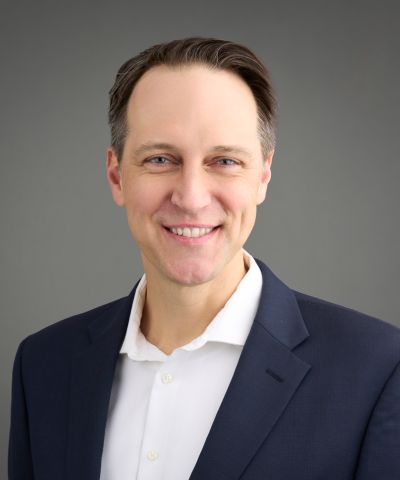
DR. RYAN WESTERGAARD
PROFESSOR OF MEDICINE, DIVISION OF INFECTIOUS DISEASE, DEPARTMENT OF MEDICINE, UW SCHOOL OF MEDICINE AND PUBLIC HEALTH
Dr. Ryan Westergaard is a faculty member of the Division of Infectious Disease within the Department of Medicine. He is a practicing clinician providing patient-centered care for people living with HIV, a clinical investigator working to improve HIV treatment and prevention, and a public health leader serving Wisconsin communities. Dr. Westergaard aims to build bridges between the scientific and educational missions of the University and the public health mission of state, local and tribal health departments, seeking to leverage UW resources for the benefit of the health of all Wisconsin residents.
Dr. Ryan Westergaard is a Professor of Medicine and the co-director of the Syndemics Research Group (SynRG) at the University of Wisconsin School of Medicine and Public Health. SynRG is a multi-disciplinary team whose mission is to conduct high impact research aimed at improving health for people and communities affected by substance use disorders, infectious diseases, and related social problems.
Since 2019, Dr. Westergaard has also served as the Chief Medical Officer for Communicable Diseases at the Wisconsin Department of Health Services, providing leadership for state and local public health agencies in the area of infectious disease surveillance, outbreak response and pandemic preparedness.
FIRESIDE CHAT PANEL:
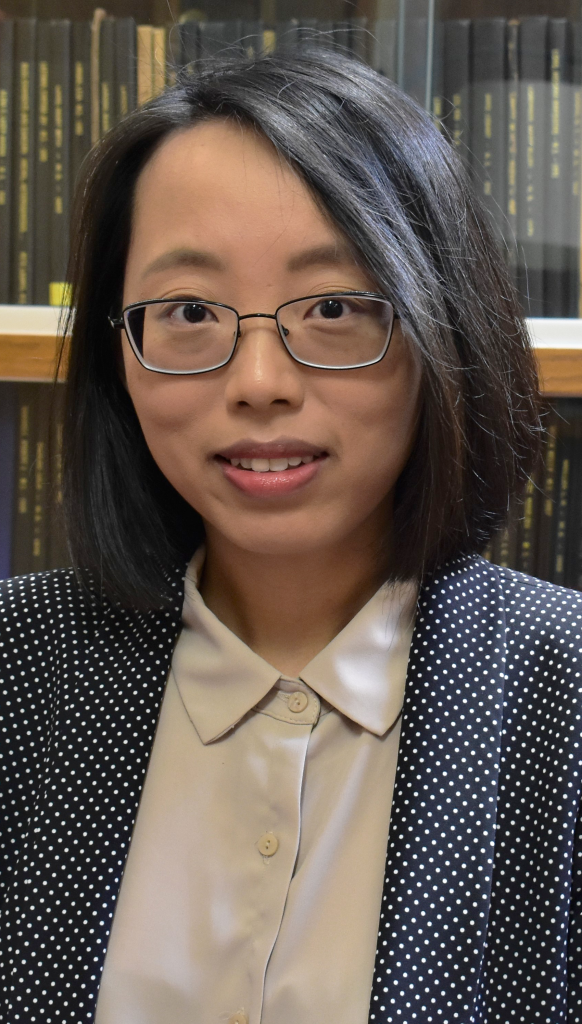
DR. NAN LI
ASSOCIATE PROFESSOR AND DIRECTOR OF GRADUATE STUDIES, DEPARTMENT OF LIFE SCIENCES COMMUNICATION, UW–MADISON
Nan Li is an associate professor and Director of Graduate Studies in the Department of Life Sciences Communication at the University of Wisconsin-Madison. She is affiliated with the Robert F. and Jean E. Holtz Center for Science and Technology Studies, the McPherson Eye Research Institute, the Office of Sustainability, and the Wisconsin Institute for Discovery. Li teaches undergraduate and graduate courses in visual communication and risk communication and advises students in both the master’s and PhD program in Science Communication.
Li’s research examines how visual communication shapes the ways people understand and engage with science. Her recent work focuses on how scientific images and data visualizations are translated by the media, how widely circulated visuals (e.g., science photos and AI-generated illustrations) shape perceptions of credibility and the issues they depict, and how science art fosters emotional engagement and self-reflection in the context of environmental risk and justice. Across this body of work, Li challenges traditional visual norms in science communication that prioritize technical accuracy and aesthetics. Instead, she collaborates with scientists, artists, and community partners to develop evidence-based strategies that center emotional resonance, co-creation, and community experience.
Her scholarship has been published on Science Communication, Visual Communication, Public Understanding of Science, Energy Policy, Climatic Change, and other leading journals, and her research and public engagement projects have been featured in over 30 domestic and international outlets, including Forbes, The Guardian, and PBS. Li’s interdisciplinary work has received support from the U.S. Department of Agriculture, the Department of Energy, the National Oceanic and Atmospheric Administration, and other agencies. She recently partners with tribal communities, museums, and local organizations to curate exhibits and conduct community-based programs that highlight ecological knowledge and the artistic traditions of Wisconsin’s Native nations.
Li serves on the Scientific Committee of the Network for the Public Communication of Science and Technology (PCST) and the Development Committee of the International Environmental Communication Association (IECA). At UW, she is a member of the College of Agricultural and Life Sciences Curriculum Committee and the Research Advisory Committee, and she also sits on the University Academic Planning Council (2025-2026).
Before joining LSC, Li held a tenure-track faculty position in the Department of Agricultural Education and Communications at Texas Tech University and was a Joan Bossert Postdoctoral Fellow in the Annenberg Public Policy Center of the University of Pennsylvania. She received her Ph.D. in Mass Communications – Science Communication from the University of Wisconsin-Madison.
A list of her publications can be found on Google Scholar.

CRYSTAL POTTS
SENIOR DIRECTOR, STATE RELATIONS & STATEWIDE OUTREACH, UW–MADISON
Crystal Potts is the Senior Director of State Relations & Statewide Outreach for the University of Wisconsin-Madison. In her role, she serves as the point-of-contact for state government relations, including the governor’s office, state legislature, and state agencies. She also assists in the creation and implementation of a statewide advocacy effort on behalf of the university.
Crystal previously served as the chief of staff to Wisconsin State Senator Howard Marklein (R-Spring Green). In this capacity, she also supported the legislature’s budget-writing Joint Finance Committee as the senate staff lead on tax and local government issues. She also served as the research assistant and staff clerk to the Committee on Ways & Means in the State Assembly early in her career at the Wisconsin State Capitol.
Originally from the Twin Cities, Crystal is a proud graduate of UW-Madison with a BA in political science and Chinese. She lives in Fitchburg with her husband, two sons, two dogs, and two cats.
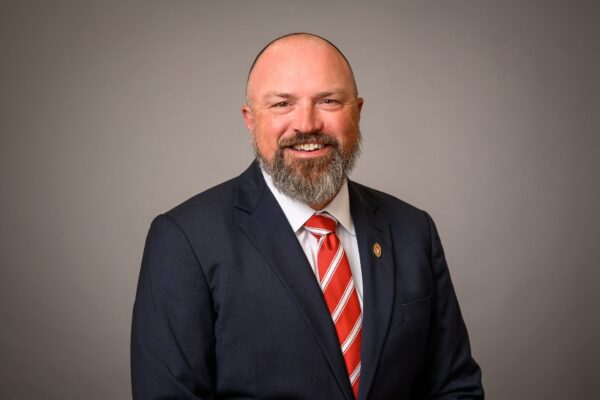
DR. KEITH POULSEN
DIRECTOR, WISCONSIN VETERINARY DIAGNOSTIC LABORATORY, AND CLINICAL ASSISTANT PROFESSOR, MEDICAL SCIENCES DEPARTMENT, UW SCHOOL OF VETERINARY MEDICINE
Dr. Keith Poulsen has been the Director of the WVDL since 2018. Additionally, he holds a joint appointment as a Clinical Assistant Professor in the Medical Sciences Department at the UW School of Veterinary Medicine and is active in teaching large animal internal medicine. Dr. Poulsen is actively involved in the Wisconsin Veterinary Medical Association (WVMA), American College of Veterinary Internal Medicine (ACVIM), National Animal Health Laboratory Network (NAHLN), and American Association of Veterinary Laboratory Diagnosticians (AAVLD). Dr. Poulsen’s interests focus on cattle health, zoonotic infectious diseases and global health.
Dr. Poulsen is a Wisconsin native and earned a BS in Biochemistry (2000) and DVM (2004) at the University of Wisconsin. He interned at North Carolina State University in the Food Animal Medicine and Surgery Program prior to returning to Wisconsin for his residency in Large Animal Internal Medicine and earned diplomate status from ACVIM in 2008. Following clinical training, Dr. Poulsen earned a PhD in Comparative Biomedical Sciences from the University of Wisconsin in 2012. He spent two years at Oregon State University as a faculty member in Large Animal Internal Medicine and returned to the Wisconsin Veterinary Diagnostic Laboratory and the School of Veterinary Medicine in 2014.
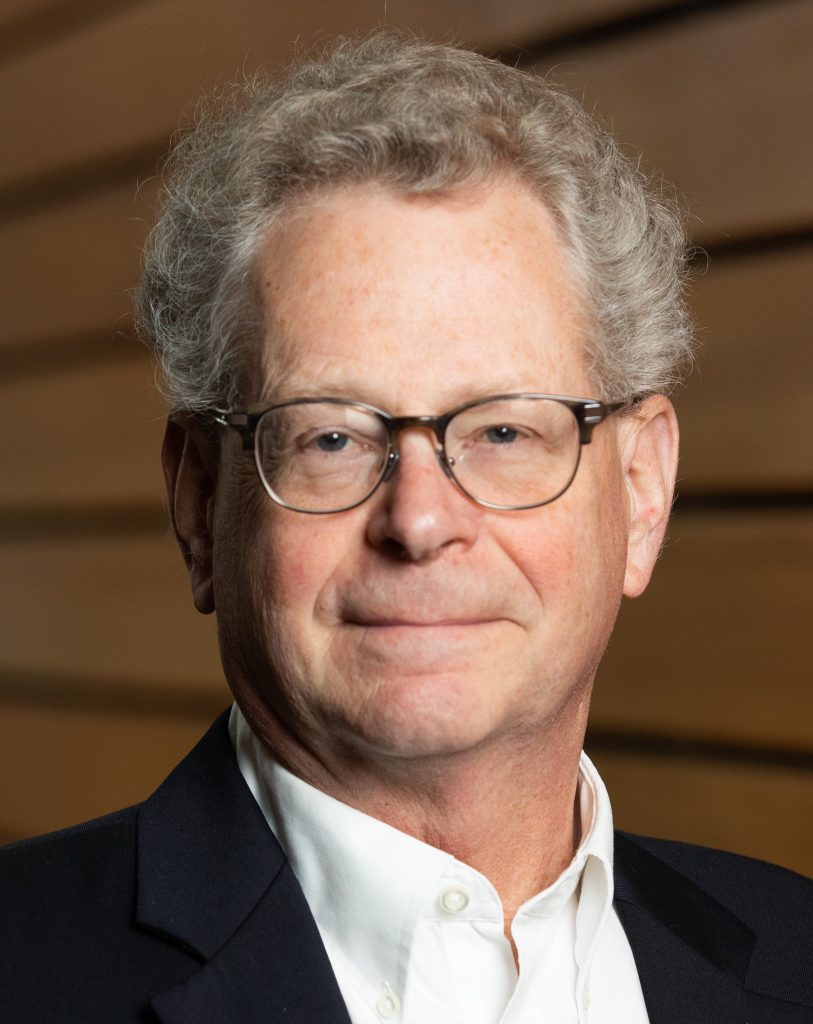
DR. CRAIG HEDBERG
PROFESSOR, DIVISION OF ENVIRONMENTAL HEALTH SCIENCES, SCHOOL OF PUBLIC HEALTH, UNIVERSITY OF MINNESOTA, AND CO-DIRECTOR, MN INTEGRATED FOOD SAFETY CENTER OF EXCELLENCE
Dr. Craig Hedberg is an Epidemiologist and Professor in the Division of Environmental Health Sciences at the University of Minnesota, School of Public Health (SPH). He serves as the Principal Investigator of the Upper Midwest Center for Public Health Preparedness and Response and Co-Director for the MN Integrated Food Safety Center of Excellence.
His most important contributions have been to advance methods for collaboration between public health and regulatory agencies, academic researchers and industry to improve foodborne illness surveillance and outbreak investigations. He promotes these same approaches to enhance public health preparedness and response, addressing key barriers to implementing evidence-based strategies and interventions.