A GHI Seed Grant Story: From Ideas to Impact
By Katie Newcomb, GHI Communications Director...When Dr. Charles Nicholson was working in Agricultural and Applied Economics in the College of Agricultural and Life Sciences at UW–Madison in 2022, he applied for and received a GHI Seed Grant to support an international, interdisciplinary workshop exploring how participatory systems modeling (PSM) approaches could address food and nutrition security under climate change.
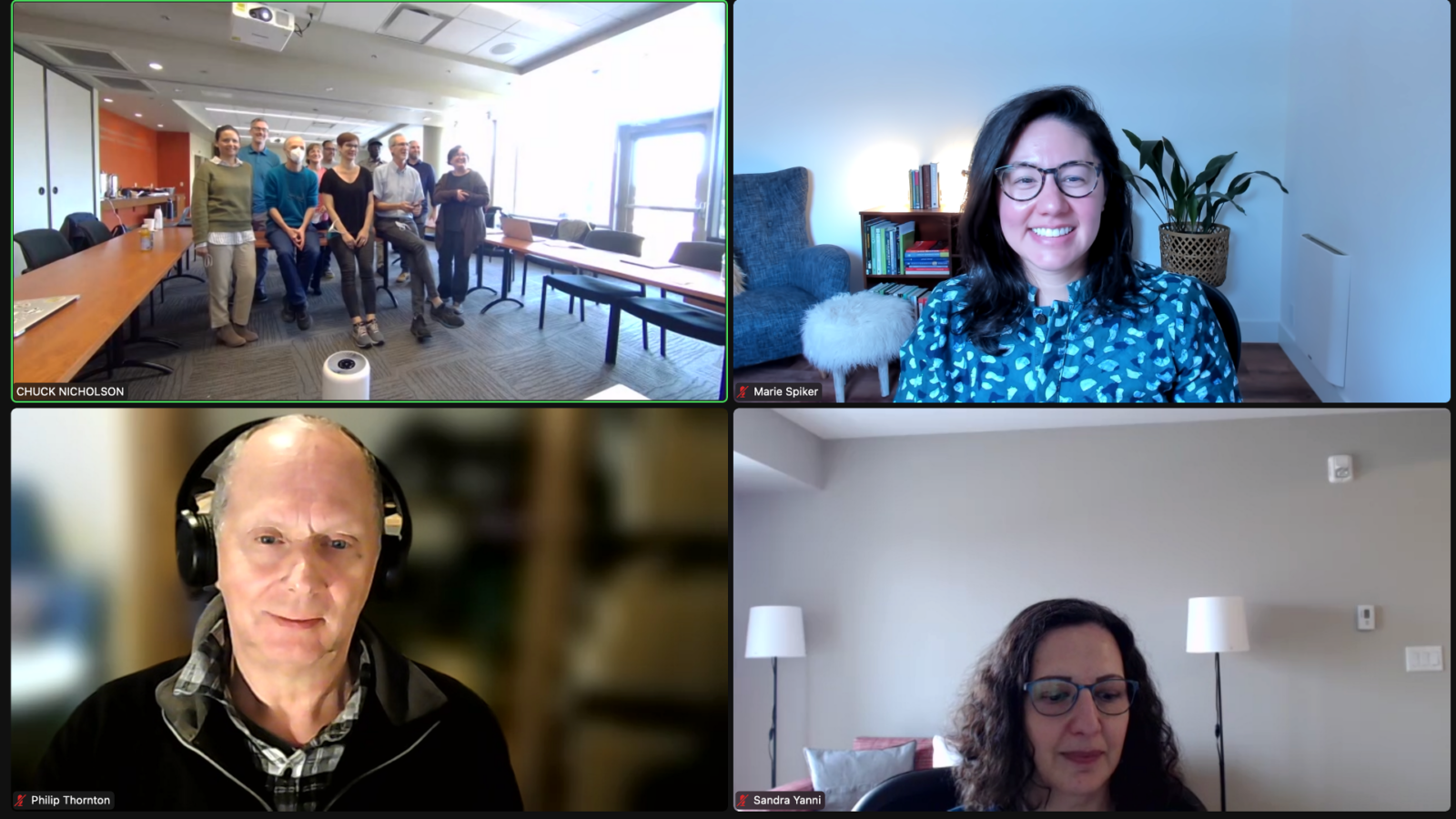
In September 2022, the hybrid workshop took place with 16 participants representing multiple disciplines from 11 different countries and various organizations.
(Screenshot photo courtesy of Dr. Nicholson)
Participants included representatives from Cornell University, University of Michigan, Swedish Agricultural University, Agriculture and Agri-Food Canada, Alliance CIAT-Bioversity, Global Alliance for Improved Nutrition, University of Bergen, Climate Change Agriculture and Food Security, University of Washington, UW-Madison, and Consultative Group on International Agriculture Research.
The result was a robust discussion through a multidisciplinary lens focused on food and nutrition security under climate change within low and middle-income countries (LMIC). Representative perspectives included those from agricultural economists and system monitors, and people from applied agricultural sciences areas such as agronomy and livestock production. And, because there was an additional focus on food and food production security, some perspectives addressed public health, food, nutrition, and food insecurity.
“One of the things that I think is key about this, is that this group of people – all of whom are interested in finding solutions and improving food security outcomes in the face of climate change – all had backgrounds in this and a connection and interest in thinking and learning in a systems modeling way.”
To foster a meaningful cross discipline discussion, they brought together a dynamic group from academia, government, NGOs, and industry. This process began years ago when Dr. Nicholson and his wife, Dr. Erica Phillips started building their network during their time attending Cornell University. Dr. Phillips also participated in this workshop as an assistant research professor in the Department of Nutritional Sciences at UW–Madison in 2022, and is a co-author on the group’s final paper.
“One of the things that I think is key about this, is that this group of people – all of whom are interested in finding solutions and improving food security outcomes in the face of climate change – all had backgrounds in this and a connection and interest in thinking and learning in a systems modeling way,” Dr. Nicholson notes. “Many had experience doing this in a participatory way with stakeholders, who have ownership of future actions, to implement recommendations.”
Prior to the workshop, members prepared a white paper summarizing what they knew about the impacts of climate change on food security in different parts of the world. This netted much information on documenting what the problem is or could be. But it didn’t necessarily answer the question of: What do we do about it?
“What you really need to do to develop solutions, is have engagement with organizations that are on the ground, working with scale, that are used to implementing actions or programs to address certain issues,” Dr. Nicholson explains. “What is unique with what we tried to do, is focusing on the involvement of the decision makers and stakeholders and implementable actions, and using a participatory process to help people learn the complexity of the system they work in and how climate change might have an impact.”

Those of us who were involved in the process in 2022, and beyond, appreciated the funding from GHI – without which, we wouldn’t have been able to do any of the things we did.”
People in the workshop were asked to include challenges faced from their perspective, and provide a critique of the PSM approach.
The result? The group agreed to work collectively to included a set of action plans, including drafting a consensus statement noting what was learned from this workshop exercise. All presentations provided by members were made accessible, and a broader public statement and perspective piece was drafted. It was decided to share the piece within academic literature to build awareness and solutions.
Tweaking the messaging approach along the way, the group gained new collaborators who are now co-authors of papers and potential sources of future funding.
The work paid off as two papers (shared below) were recently featured in Frontiers in Sustainable Food Systems.
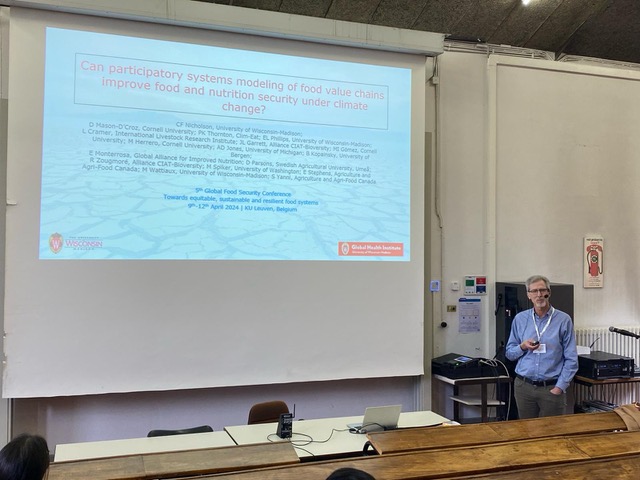
A question from one reviewer further refined their work by identifying opportunities to PSM to others around the world. The group went back to identify and share how to build capacity for PSM in LMIC. Dr. Nicholson presented a paper about the work at the 2024 Global Health Security Conference in Belgium.
(Photo courtesy of Dr. Nicholson)
Although Dr. Nicholson and Dr. Phillips are now at Penn State University, they continue to network with workshop participants and other collaborators to advance the group’s goals. continue the work.
-
Paper in ‘Frontiers in Sustainable Food Systems’: Participatory systems modeling to identify and support gender-responsive agri-food system strategies
-
Paper in ‘Frontiers in Sustainable Food Systems’: Participator systems modeling of food value chains to improve food and nutrition security under climate change
Dr. Nicholson shares, “Those of us who were involved in the process in 2022, and beyond, appreciated the funding from GHI – without which, we wouldn’t have been able to do any of the things we did. I think it’s a nice story about leveraging a relatively small amount of funding to put together a team of people to share the kind of conversations that we had at the workshop and beyond with a broader international audience.”
Find more information about past GHI Seed Grants here. And for more information about the 2026-27 GHI Seed Grants, please click here.